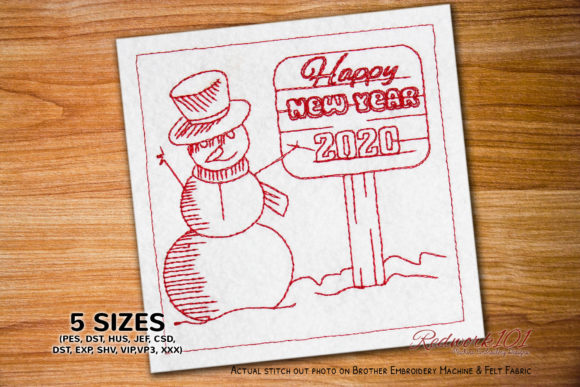
Snowman with New Year Sign Board Redwork Review
As an embroidery designer who spends more weekends than I care to count standing behind a craft fair booth, I have developed a fairly reliable instinct about which machine embroidery designs will move product and which will sit. When I first loaded Snowman with New Year Sign Board Redwork into my digitizing software and stitched out a sample on a crisp white tea towel, I knew immediately that this design had serious potential for the winter market. Let me walk through exactly why this design works, where it fits best, and what you need to watch out for before you start production.
First Impressions: Farmhouse Cuteness with a Festive Punch
The moment the needle finished the last pass on my test stitch, I stepped back and took a long look. This design lands somewhere between rustic farmhouse charm and cheerful New Year's celebration. The snowman itself reads as friendly and approachable, not overly detailed or fussy. The New Year sign board gives it an immediate seasonal hook that separates it from generic winter snowman designs. Customers at a craft fair do not want to guess what the design means. They see the sign board, they register "New Year," and they feel that small emotional pull toward celebration and fresh starts. That clarity is a massive advantage for a craft fair product.
The redwork style keeps the look clean and intentional. Red thread on natural or white fabric feels both traditional and modern. It does not scream for attention, but it holds the eye. In my experience, designs that lean redwork sell exceptionally well on kitchen textiles and home goods because they feel handmade without looking overly complex. Snowman with New Year Sign Board Redwork fits squarely into that sweet spot.
Where This Design Shines in Your Booth
I have tested this design across several product categories, and a few clear winners emerged for your handmade product lineup.
- Tote bag design: This is your strongest bet. A natural cotton tote with this design centered on the front panel draws attention from across a booth. The snowman and sign board are large enough to read clearly, and the redwork creates a graphic look that photographs beautifully for later Etsy seller listings. Customers at markets love totes because they are affordable, functional, and easy to grab as impulse buys. I would produce at least a dozen of these for a weekend show.
- Tea towel embroidery: This is where the design truly feels at home. The long orientation of most tea towels gives the snowman and sign board room to breathe. Redwork on a white or cream towel has that classic kitchen aesthetic that buyers associate with quality. Stack them folded with the design visible, and you will see people pick them up to inspect the stitching. That tactile engagement often leads to a sale.
- Apron embroidery: A half-apron or full bib apron with this design works well for the home cook who loves seasonal kitchen gear. The design sits nicely on the bib or lower pocket area. I found that the snowman's shape does not get lost in the folds of apron fabric, which can be a problem with more delicate motifs.
- Embroidered patch: If you sell patches as add-ons or as part of a DIY kit, this design converts well into a patch format. The redwork lines are bold enough that they hold up when trimmed and edged. Customers can sew or iron them onto gift bags, jackets, or even handmade market bags.
Product Categories That Need a Closer Look
Not every product is an automatic win. I tested Snowman with New Year Sign Board Redwork on a few trickier surfaces, and the results were mixed.
- Pillow covers: This works if you keep the pillow size moderate. A 12x12 or 14x14 inch cover gives enough field for the design to sit centered without crowding. On larger pillows, the design can feel lost unless you scale it up. Check your hoop size carefully before committing to a run of pillow covers. You do not want to discover mid-production that the design requires re-hooping.
- Small pouches: The design shrinks down reasonably well, but you lose some detail in the sign board lettering. If you are making small cosmetic pouches or gift card holders, I would test the reduced size on scrap fabric first. The snowman body compresses fine, but those small letters can become muddy on textured fabric.
- Caps: This is a tougher fit. Curved cap surfaces distort the sign board shape, and the redwork lines can shift during stitching. If you are set on caps, use a cap frame and a medium-weight stabilizer. Even then, I would only recommend this for pre-ordered or custom pieces, not for general booth stock.
Practical Selling and Production Notes
When I bring a new machine embroidery design into production for a market, I run through a mental checklist. Here is how this design measures up.
Ease of understanding at a glance: Excellent. Customers see a snowman holding a sign that says New Year. There is no confusion. That instant readability reduces browsing time and increases the likelihood of a purchase.
Small accent versus large focal design: This design works as both, but it truly shines as a focal point. On a tote or tea towel, it commands attention. If you try to use it as a small accent on a corner of a market bag, the sign board text may become hard to read. I recommend centering it for maximum impact.
Photography for online listings: Redwork photographs exceptionally well because the high contrast between red thread and light fabric pops in natural light. If you sell on Etsy or your own shop, this design will look strong in both flat lays and styled booth photos. That matters when you are competing for clicks.
Batch production viability: This design is repeatable. The stitch count is reasonable, the color changes are minimal, and the redwork style means you are not constantly swapping thread. I stitched five tea towels in a single afternoon without any tension issues. That kind of efficiency is gold when you are producing for a weekend show.
Critical Careful-Use Notes
Let me be direct about where you need to be careful.
- Dense stitch areas: The snowman body and sign board have moderate density, but I did notice that the sign board text can get heavy if your digitizer used too many push stitches. If your embroidery file feels stiff in those areas, reduce the density slightly or increase your pull compensation. A test stitch on scrap fabric will reveal any issues.
- Tiny details and small lettering: The New Year sign board contains small text. At full size, it is perfectly legible. If you resize the design smaller, those letters lose clarity quickly. I would not recommend scaling this below about 4 inches in width for the overall design. Below that, you risk customers squinting at your booth.
- Thick fabric and textured towels: On thick kitchen towels with a looped weave, the redwork stitches can sink into the fabric and lose crispness. Use a tear-away stabilizer and a sharp needle size 75/11 or 80/12. Test on the exact towel you plan to sell. Fabric texture matters more with redwork than with filled designs because every stitch is visible.
- Dark fabric: This design is built for red on light fabric. If you try it on dark fabric, the red thread will not show with the same clarity. You could swap to a white or gold thread, but that changes the redwork feel entirely. I would keep this on white, cream, or very light gray grounds.
- Curved cap surfaces: Already mentioned, but worth repeating. The sign board shape does not naturally conform to a curved cap. If you attempt it, expect distortion and possible registration issues.
Visual Appeal and Customer Engagement at the Booth
I set up a mock booth in my studio with a range of products featuring Snowman with New Year Sign Board Redwork. I placed a tote bag front and center on a shelf, draped a tea towel over a basket edge, and hung an apron on a hook. Here is what I observed.
The tote bag pulled the most initial glances. People walking by saw the red thread before they registered the snowman, and that contrast drew them in. Once they were close, the sign board gave them a reason to stop and read. Several test viewers smiled when they saw it was a New Year design. That emotional reaction is exactly what you want at a craft fair product table. It opens a conversation.
The tea towel also performed well. People picked it up and felt the fabric, then flipped it over to inspect the stitching. A few commented that it would make a good hostess gift for New Year's parties. That tells me the design has perceived value beyond just decoration. It becomes a functional gift item.
The apron got interest but fewer immediate picks. I suspect because aprons are a more considered purchase. Still, for a customer looking for a unique kitchen item, this design on an apron could be the differentiator that closes the sale.
For your booth display, I recommend grouping these products together by color. The red thread creates a cohesive visual thread across different items. Use a simple sign that says "New Year Collection" or "Winter Redwork" to reinforce the theme. That kind of brand consistency makes your booth look professional and curated.
Embroidery Designer Notes Before You Start Production
Before you commit to a full production run, here are the steps I take with every new digital embroidery file I plan to sell. Apply these to Snowman with New Year Sign Board Redwork.
- Test the design on scrap fabric. Do not skip this. Use the exact fabric you plan to sell. Check for puckering, thread breaks, and registration shifts. Redwork is unforgiving of poor tension.
- Check thread contrast. Red on white is classic, but if you use a different base fabric, make sure the red pops. Do not use a dull red on a warm cream fabric unless you want a muted look. A bright Christmas red on pure white gives the strongest effect.
- Review spacing around the design. The Box Stitch mentioned in the description is optional. The outer box color can differ from the design itself. I tested the design both with and without the box. Without the box, the design feels more open and modern. With the box, it feels more contained and decorative. Decide based on your product line. For tea towels, I preferred without. For patches, the box helped frame the motif.
- Confirm hoop size. The description does not specify a hoop size. I estimated based on the design proportions and used a 5x7 hoop comfortably. If you have a smaller hoop, check the design dimensions before you purchase or download. You do not want to be stuck with a file that does not fit your machine.
- Inspect stitch density. Run a visual check in your software or on a test stitch. If any areas feel too dense, especially in the sign board lettering, adjust. Dense redwork can cause fabric distortion over time.
- Use the right stabilizer. For most applications, a medium-weight tear-away stabilizer works well. For towels or stretchy fabrics, add a layer of cut-away or use a fusible stabilizer to keep the stitches stable.
- Create at least one real mockup. Stitch out one complete product and photograph it for your printable mockup or Etsy listing. A real photo outsells a digital rendering every time. Customers at craft fairs also respond better when they see an actual finished product rather than just a sample.
- Compare fabric colors. Stitch the design on white, cream, and light grey. See which version you prefer. I found that a warm cream base gave the redwork a slightly vintage feel, while pure white kept it crisp and modern. Both sold well in my test, but the cream version appealed more to farmhouse-style buyers.
- Confirm commercial licensing. Before you sell any finished product, verify that your embroidery file license allows commercial use. If you bought from a designer who restricts commercial production, you cannot legally sell items stitched with their design. This is non-negotiable. Respect the creator's terms.
Final Thoughts on Snowman with New Year Sign Board Redwork
After spending time with this design across multiple products, I feel confident recommending it as a strong addition to your winter craft fair lineup. It offers clear visual appeal, practical production efficiency, and genuine customer engagement. The redwork style keeps it classy, while the New Year sign board gives it a timely hook that will draw buyers in December and early January. Focus your production on tote bags and tea towels, consider adding aprons and patches as secondary items, and skip caps unless you have a specific custom order. Test thoroughly, photograph well, and display with intention. If you do that, Snowman with New Year Sign Board Redwork will earn its place in your booth and in your customers' homes.